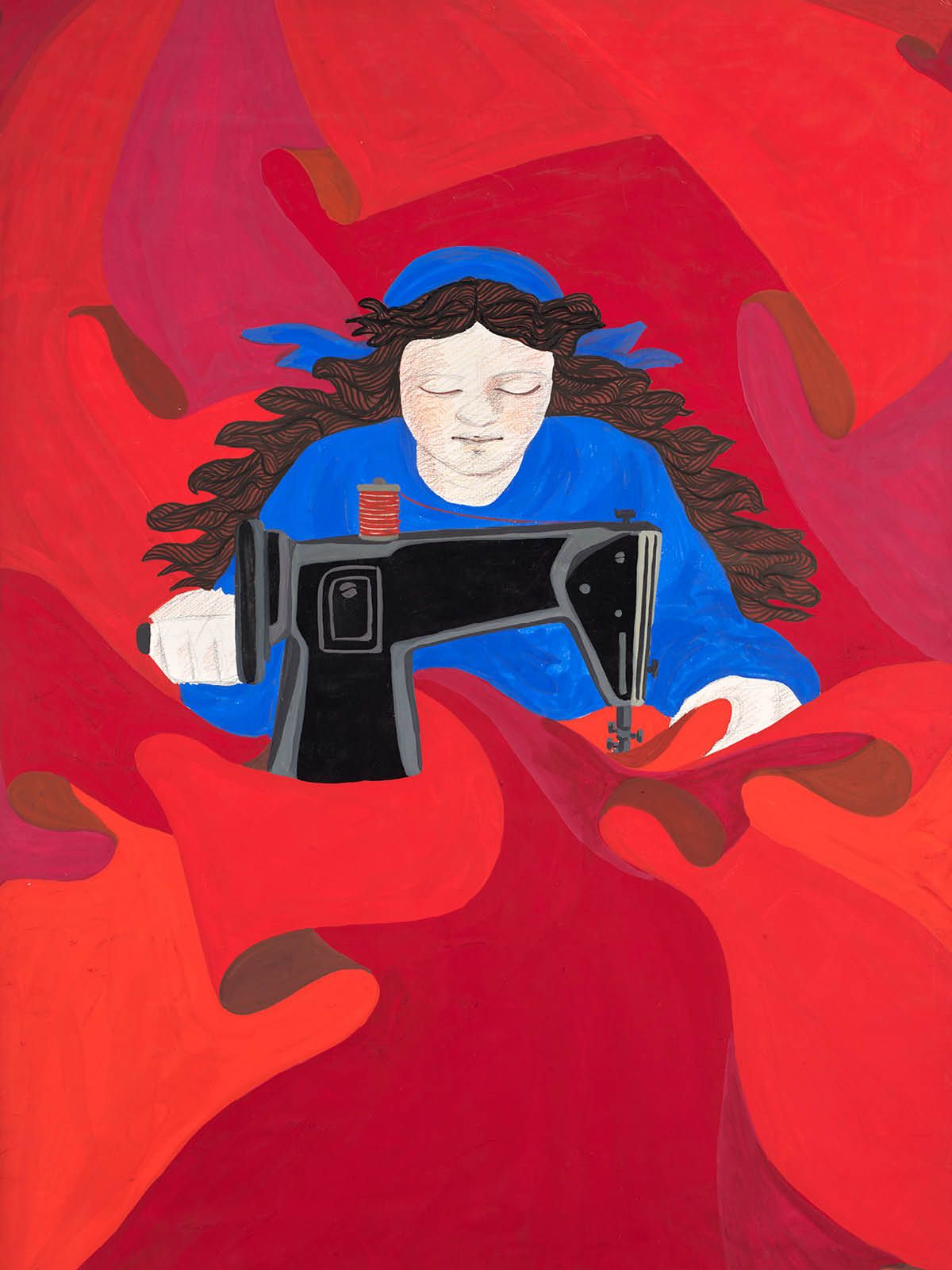
7. Berliner Herbstsalon ЯE:IMAGINE: Aşk, Mark ve Ölüm
8/May-27/June at Depo Istanbul
Aşk, Mark ve Ölüm is a 1982 song by Ideal, a Berlin-based band from the Neue Deutsche Welle movement. Even back then, the band knew who was indispensable to the creation of a new Germany. They asked the writer Aras Ören to write the lyrics. Born in Istanbul in 1939, he moved to West Berlin in 1969 after working as a dramaturge and actor in Istanbul. The first volume of his Berlin trilogy, the poem Was will Niyazi in der Naunynstraße? (What Does Niyazi Want on Naunynstraße?) was published back in 1973. In 1982, he wrote Aşk, Mark ve Ölüm, a poem capturing the disappointment felt by immigrants in Germany. This was a time of rapidly rising xenophobia, accompanied by racist debates in the media and politics about »Überfremdung«. Aras Örens translation ends with the lines:
»I howl, I scream, and I batter down
With a loud voice, with a soft voice
The walls everywhere, everything is deaf
Death comes cheap to us.«
Aşk, Mark ve Ölüm is also the title of a highly acclaimed 2022 documentary by German director Cem Kaya (born 1976) on the musical cultural history of Turkish migrants. He was inspired by the compilation Songs of Gastarbeiter by the DJ duo Ayata/Kullukcu. This compilation was released as part of Almancı – 50 Years of Sham Marriages, a 2011 festival. The festival, under Shermin Langhoffs artistic direction, celebrated 50 years of resistance at Ballhaus Naunynstrasse in Berlin and Istanbul, marking the anniversary of the recruitment agreement. With the exhibition Aşk, Mark ve Ölüm, we return to Istanbul with the »Almancı«, as the emigrants are called in Turkey. This time, on the occasion of the upcoming 65th anniversary and in collaboration with the Maxim Gorki Theater, which, under Langhoffs artistic direction since 2013, has also been presenting visual art in the theater through its biennial Berliner Herbstsalon. The exhibition, on view from May 8 to June 27 at Depo Istanbul, presents in two parts a small but significant selection from the 7th and final Berliner Herbstsalon at the Gorki.
AŞK, MARK VE ÖLÜM I
With the exception of a few works by Melek Konukman-Tulgan, Filiz Taşkın, Serpil Yeter, and Gülsün Karamustafa, the first part is documentary in nature. It is based on research and focuses on the residents of the dormitory at Stresemannstraße 30 in Berlin, which the Telefunken company established for its »guest workers«. Even here, the work of Emine Sevgi Özdamar plays an important role. Born in 1946 in Malatya in Eastern Anatolia and raised in Istanbul and Bursa, she arrived at Stresemannstraße 30 in 1965. She recounts her life in the »Wonaym«—balancing work at Telefunken with a longing for the theater and for a world free of exploitation and oppression—in her novel Die Brücke vom Goldenen Horn (The Bridge from the Golden Horn) (1998), the first volume of her Istanbul-Berlin trilogy. On the long journey from Istanbul to Berlin, one of her fellow travelers says, »What a never-ending journey«. It has not ended to this day. The dream of a better world, which once seemed so close, is receding into the distant horizon once more.
In the second volume, Seltsame Sterne starren zur Erde (Strange Stars Stare Down at Earth), she writes: »I am unhappy in my language. The words are sick. My words need a sanatorium. How long does it take for a word to heal again? They say that in foreign countries you lose your mother tongue. Can't you also lose your mother tongue in your own country?«
These are phrases that were once very well understood in Germany. Back when people there still felt ashamed of what their parents and grandparents had done to their mother tongue by associating it with that of the Third Reich. Emine Sevgi Özdamar went to the theater, to Brecht and Weigels Berliner Ensemble, to heal the words. She was not the first, nor was she the only one there. Nuran Oktar and Vasıf Öngören, who had worked for a year and a half as directors of the dormitory on Stresemannstraße, had also come to Berlin for the theater. The theater also thrives on helping to heal the world. No one can do this alone, and certainly not a »nation«. A nation depends on other people, on other languages. That was the experience of the women at Stresemannstraße 30, the immigrant women from many nations. That is what we are working on at the Maxim Gorki Theater. There, we are working on a new theater for the new post-migrant Germany. Yet another new German wave.
AŞK, MARK VE ÖLÜM II
In the second part of the exhibition Aşk, Mark ve Ölüm, artists engage with Germany through video works, scripts, and sculptures, many inspired by their own lives. Artists include Nevin Aladağ, Züli Aladağ, Cana Bilir-Meier, Zühal Bilir-Meier, Ahu Dural, Semra Ertan, Harun Farocki & Antje Ehmann, Daniel Knorr, Hakan Savaş Mican, Ersan Mondtag, İrfan Önürmen, Emine Sevgi Özdamar, Ülkü Süngün, and Želimir Žilnik.
The exhibition is complemented by a supporting program of artist talks, lectures, and screenings. At the opening on 8/May, singer, performer, and director Nihan Devecioğlu will perform, and Emine Sevgi Özdamar will speak. On 9/May, we will screen recordings of the theater productions Dschinns by Fatma Aydemir, directed by Nurkan Erpulat, and Unser Deutschlandmärchen by Dinçer Güçyeter, directed by Hakan Savaş Mican. Each screening will be followed by a discussion with the authors and directors. Aydemir and Güçyeter belong to the so-called second generation of immigrants in Germany and, like Ören and Özdamar, are indispensable to German-language literature. Both authors have also recently been published in Turkish translation in Turkey. On10/May, we will meet third-generation artist Cana Bilir-Meier, who is represented in the exhibition with three of her own works and has also brought along works by both her mother, Zühal Bilir-Meier, and her aunt, the writer Semra Ertan. Semra Ertan, born in 1957, moved to West Germany in 1971 to join her parents. She worked as a technical draftsman and interpreter and wrote over 350 poems. On May 26th, 1982, Semra Ertan set herself on fire in Hamburg to take a stand against xenophobia in Germany. She died two days later on May 28th 1982.
On the second weekend of the exhibition, 16/May, some of the women from the dormitory at Stresemannstraße 30—including Mevhibe Çetin, Nuran Dirlikli, Aysel Göksu, and Sabahat Tezyel—will be present in person for a discussion. Another protagonist of the first generation and the first graduate of Turkish descent at the DFFB in Berlin in 1980 is the actress, director, and Gorki Ensemble member Sema Poyraz. She will join us on 16/May for a discussion featuring two short films. Prior to the events with the protagonists, on 15/May, we will hear a lecture by Ayfer Bartu titled Almanyaya Giden İlk Kuşak Kadın İşçiler (The First Generation of Female Migrant Workers in Germany). The exhibition at Depo is open from 8/May to 27/June; there will be regular guided tours, and for the closing event on 27/June, we will screen Aşk, Mark ve Ölüm by Cem Kaya, followed by a discussion with the director.
A project by Shermin Langhoff in collaboration with:
Dramaturgy Erden Kosova Exhibition Scenography Alice Faucher Curatorial Assistant Maral Müdok Assistant to the Artistic Director Thalia Hertel Research Team Hülya Karcı, Erden Kosova, Tunçay Kulaoğlu, Maral Müdok & Mürtüz Yolcu Production Manager Ece Tufan Production Assistant Marta Stein Coordination Çiğdem Özdemir Film Coordination Gari Vanisian Exhibition Design Assistants Martha Bamberg & Ruby Wisdom
A production of the Maxim Gorki Theater in cooperation with Anadolu Kültür, with the kind support of the Goethe-Institut Istanbul and Theater findet Stadt e.V.
Image Credit: Gülsün Karamustafa, 1st of May 1977 (1977), Poster for the 7th Berliner Herbstsalon ЯE:IMAGINE, curated by Shermin Langhoff, Maxim Gorki Theater. Courtesy of Museum of Modern Art in Warsaw.
Title Credit: Aras Ören, Aşk Mark ve Ölüm (1982).